
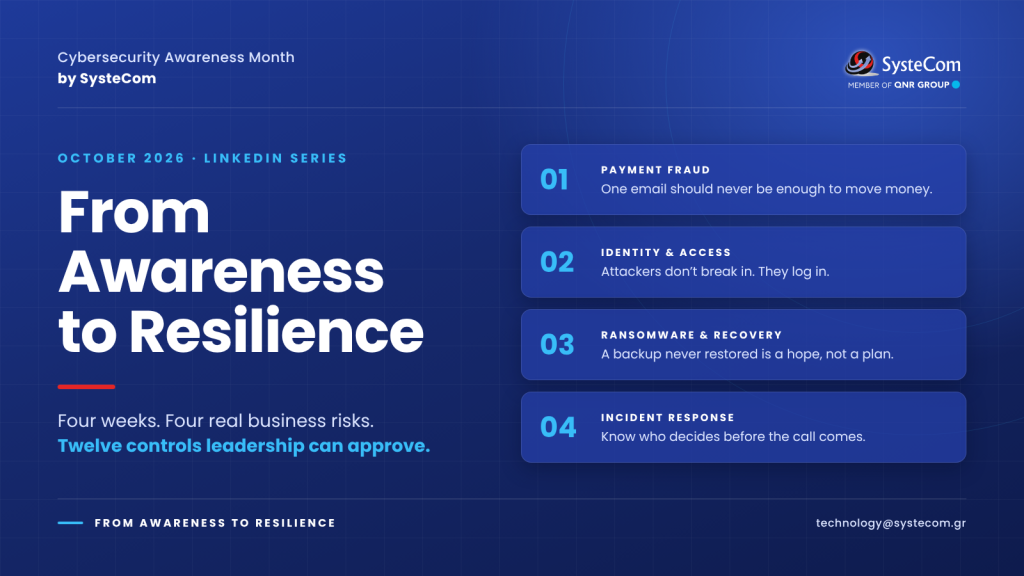
Throughout October, SysteCom marked Cybersecurity Awareness Month with “From Awareness to Resilience”, a four-week LinkedIn series built for business leaders, not just IT teams.
Every October, Cybersecurity Awareness Month puts digital risk in the spotlight. Awareness is where protection starts, but it is not where it ends. Knowing that a threat exists does not stop a fraudulent payment, a stolen login or a ransomware attack. What stops them is a business that has already decided how it will respond.
That idea shaped our campaign. Each week, we took one real business risk and turned it into three practical controls that a leadership team can approve. Each post closed with a simple “business test”: a realistic scenario and a few questions that show in seconds whether an organisation is ready, or where the gap is.
Four weeks, four business risks
Week 1: Payment fraud
“The most expensive email your company will ever receive may contain no malware at all.”
Business Email Compromise needs no hacking. A familiar name, the right tone and an urgent request to pay a new bank account can be enough. AI is making these fakes harder to spot every month. The real weakness is often not the technology but the way a business makes decisions.
The controls we proposed:
- Callback rule: changed payment details are verified through a trusted second channel.
- Dual approval: sensitive transfers need two authorised approvers.
- Leadership cover: management makes it clear that verifying a request will never get anyone in trouble.
One email should never be enough to move money.
Week 2: Identity and access
“Most attackers don’t break in anymore. They log in.”
Leaked, reused and phished passwords turn a single login into a company-wide breach. One stolen credential can open email, cloud applications and finance systems. The most valuable accounts belong to executives and administrators.
The controls we proposed:
- MFA where it matters: no critical system, from email to remote access and cloud apps, opens with a password alone.
- Stronger proof at the top: executives and administrators use phishing-resistant methods such as passkeys or security keys.
- No exceptions: leadership enrols first, and says so publicly.
A password alone should never be enough to open the business.
Week 3: Ransomware and recovery
“Your backups are the first thing ransomware looks for.”
Modern ransomware destroys recovery options first, so paying looks like the only way out. Ransomware does not just lock data; it stops the business. The cost of downtime often exceeds the ransom itself.
The controls we proposed:
- One copy out of reach: at least one immutable or offline backup that attackers cannot alter or delete.
- Recovery targets set by the business: leadership defines acceptable downtime and data loss for every critical service.
- Proven, not assumed: regular restore tests, with results reported to management.
A backup you have never restored is a hope, not a plan.
Week 4: Incident response
“The worst time to write a crisis plan is during the crisis.”
In a cyber incident, every hour without a decision costs money. Under NIS2, cybersecurity is a management responsibility, and significant incidents require an early warning within 24 hours. What turns an incident into a crisis is often an organisation that does not know who decides.
The controls we proposed:
- Clear decision rights: named owners across leadership, IT, legal, communications and the DPO.
- Partners on standby: incident response, legal and PR support agreed before they are needed.
- Rehearsed at the top: an executive tabletop exercise at least once a year.
A plan no one has rehearsed is just a document.
A word from our CEO
“Cybersecurity Awareness Month is an important reminder, but awareness on its own does not protect a business. Most of the incidents we see do not start with sophisticated technology. They start with an urgent email, a reused password, an untested backup or a crisis where no one is sure who decides. Those are leadership questions as much as technical ones.
With ‘From Awareness to Resilience’, we wanted to speak directly to the people who make those decisions. Every control in the series is something a management team can approve in a single meeting, and every business test is something they can try the next morning. With NIS2 making cybersecurity a management responsibility, that conversation cannot wait.
At SysteCom, our role is to help organisations turn awareness into readiness: to find where they are exposed, close the gaps and build the resilience to keep operating when a threat arrives. Awareness tells you what to look for. Resilience determines what happens next.”
Dimosthenis Georgacopoulos, CEO, SysteCom
How resilient is your business today?
Each of the four business tests ended with the same line: if the answer isn’t an immediate “yes”, you’ve found the gap. Would your team stop a fraudulent payment? Would every critical system demand more than a password? Would you be back up and running by Monday noon? Would everyone know who is in charge at 10 p.m. on a Friday?
If any of those questions gave you pause, we can help. SysteCom works with organisations to identify their exposure, assess their controls and strengthen the people, processes and technology that protect critical business operations.
Know the risk. Close the gap. Build resilience.
Contact our team at technology@systecom.gr, and follow SysteCom on LinkedIn to see the full “From Awareness to Resilience” series.

